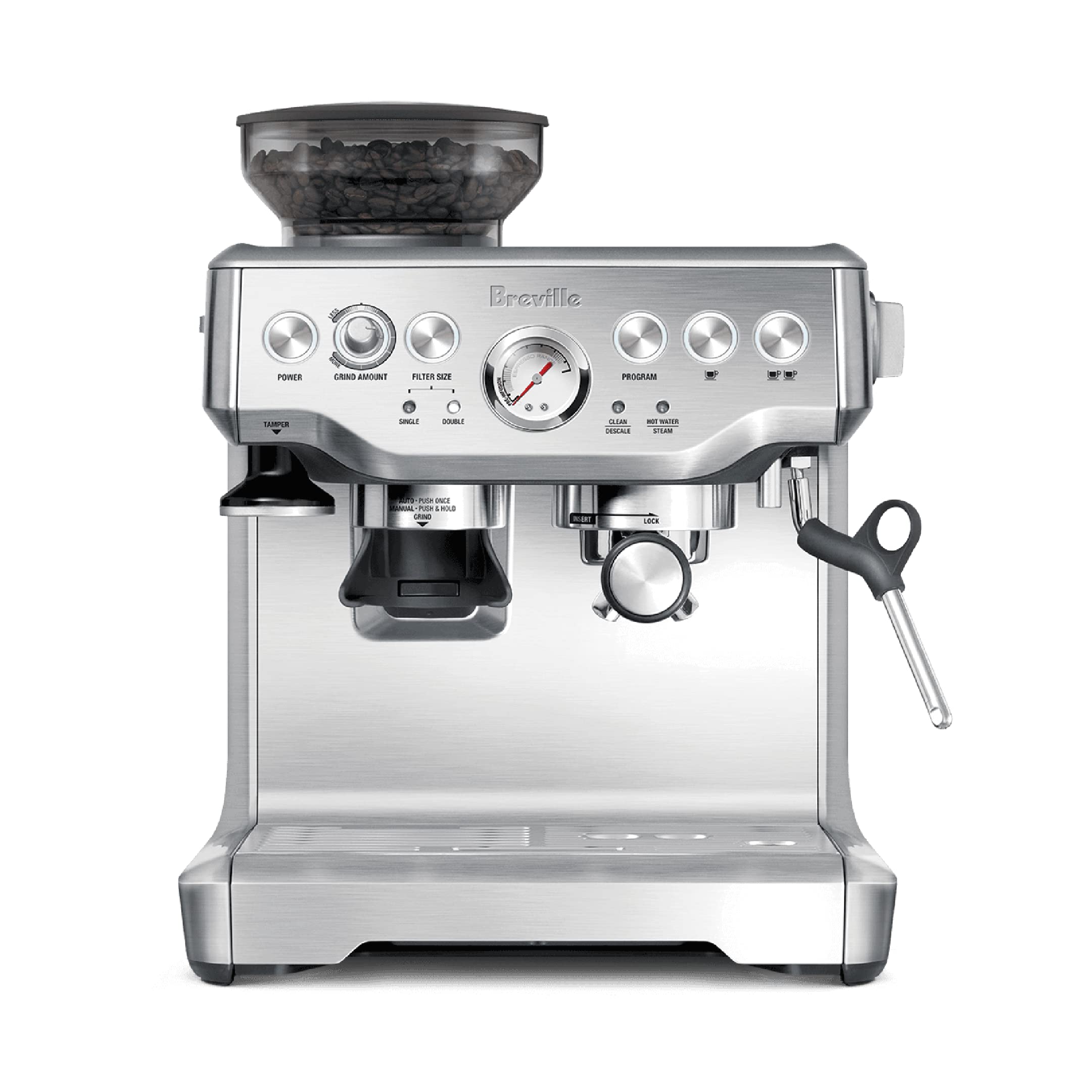
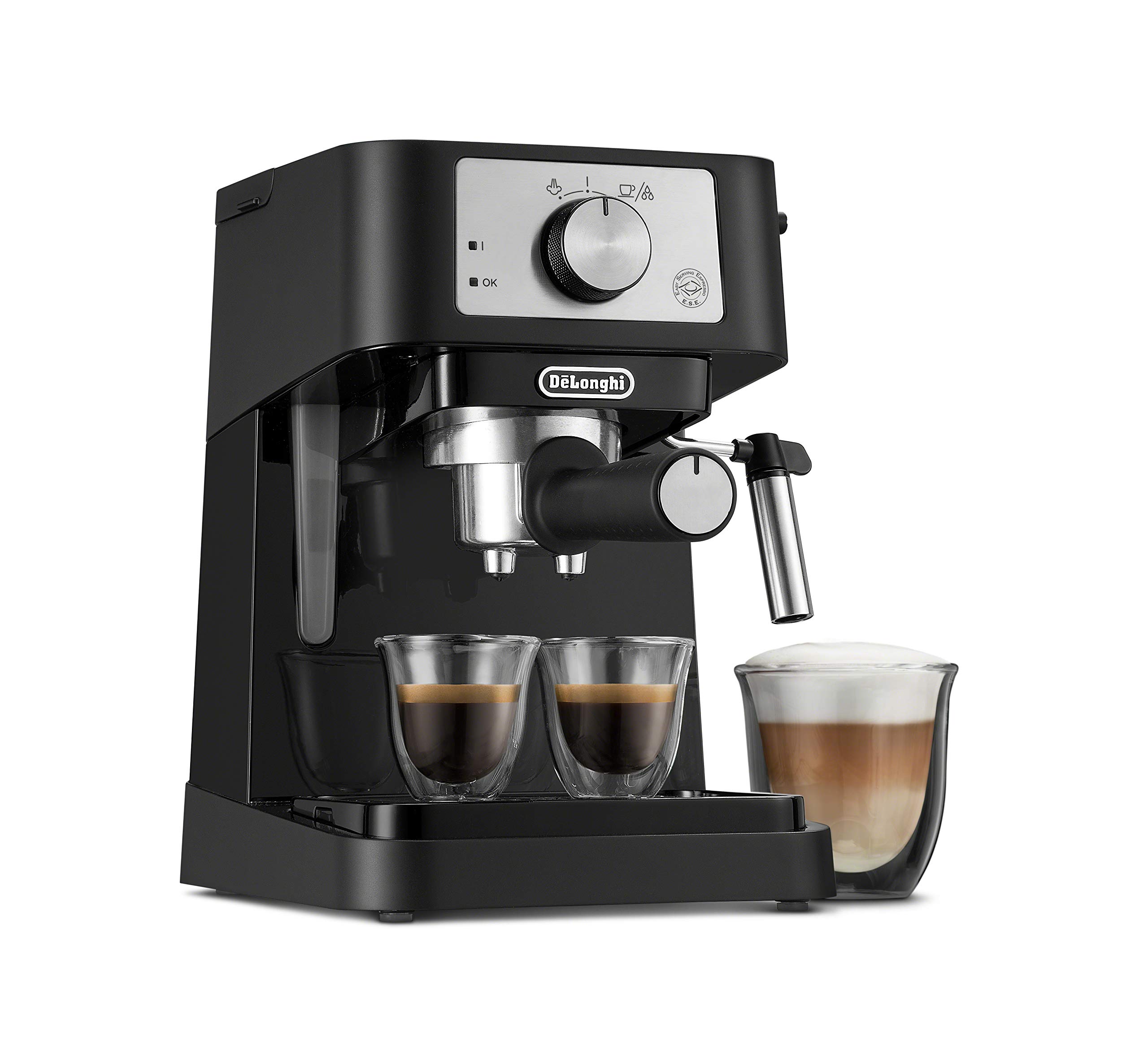
The Breville Barista Express sits at around $550. The De'Longhi Stilosa sits at around $100. That's a $450 gap, and we'll say it up front: these two espresso machines aren't really fighting for the same buyer. One is a commitment device. The other is a cheap way to find out if you even like pulling shots at home.
The Quick Espresso Verdict
The Stilosa is the right pick if you're learning espresso on a budget. The Barista Express is the right pick if you've already decided home espresso is part of your life. The $450 gap mostly buys you a built-in grinder. Worth it for some, overkill for others.
Both machines pull 15 bar shots. Both have steam wands. Both have north of 13,000 buyer reviews on Amazon. The difference isn't really about espresso quality at the basket, it's about what gets bundled, what gets built, and what you'll end up buying later. The Barista Express scores above 8 in our model. The Stilosa scores higher still on value alone, because its price floor is so low.
What You Get for $100 vs $550 in an Espresso Machine
The single biggest difference is the grinder. The Breville Barista Express has a conical burr grinder built into the top of the machine. You drop beans in, hit a button, and ground coffee drops straight into the portafilter. The De'Longhi Stilosa has no grinder at all. You either buy pre-ground coffee (which will always make mediocre espresso) or you buy a separate grinder.
Build quality splits the same way. The Barista Express is stainless steel, around 22 pounds, and takes up real counter space (about 14 inches wide and 16 inches tall). The Stilosa is mostly plastic, under 10 pounds, and much smaller. For a studio apartment or a tight galley kitchen, that size difference is not a small thing. For a committed home barista, the heft of the Breville is part of the appeal, it doesn't walk across the counter when the pump kicks in.
The steam wands are also not comparable. The Stilosa ships with a panarello wand, which is the training wheels version of milk frothing, it injects air in a fixed pattern and produces foam that's fine for a cappuccino but won't get you latte art. The Barista Express has a manual steam wand you control yourself, which is harder to learn but can texture milk properly.
Ratings tell their own story. The Breville sits at 4.4 stars across close to 27,000 buyers, which is unusually high for a $550 prosumer machine. The Stilosa sits at 4.2 stars across north of 13,000 buyers. Both are high for the category average of 4.2 across the eight espresso machines we track.
The Grinder Question
This is where the Stilosa's price tag gets complicated. A decent entry-level burr grinder for espresso runs $150 to $250. The Baratza Encore ESP is around $200. The Eureka Mignon starts above $300. If you're serious about espresso, pre-ground coffee is a non-starter, it goes stale within days of grinding and you can't dial in extraction without fresh grounds.
So the real cost of a Stilosa setup, assuming you care about the coffee and not just the novelty, is closer to $250 or $350 once you add a grinder. That closes the price gap with the Barista Express meaningfully. You're no longer comparing $100 to $550, you're comparing a $300-ish split system to a $550 all-in-one.
The Barista Express bundles the grinder at the cost of flexibility. You're locked into Breville's grinder choice, and if the grinder fails (it's the most mechanical part of the machine), you're looking at a repair or a full replacement. A separate grinder can be upgraded or swapped out on its own. Both paths are valid. Which one fits depends on how much you want to tinker.
Daily Use and the Espresso Learning Curve
Both machines demand that you learn to dose, tamp, and time your shots. Espresso is hard. Buyers mention a steep learning curve on both, that's not a knock on either machine, it's the nature of the drink.
The Stilosa has fewer features, which is its own kind of advantage. There's less to fiddle with, fewer settings to second-guess, fewer ways to blame the machine when a shot tastes off. The Barista Express has a pressure gauge on the front, dose presets on the grinder, a hot water spout for Americanos, and a pre-infusion step. More tools, more knobs, more things to dial in.
Buyers report that the Stilosa's pressurized portafilter makes it more forgiving of grind inconsistency, which matters a lot if you're using pre-ground coffee. The Barista Express ships with both pressurized and non-pressurized baskets, so you can start easy and graduate to the harder basket as your skills improve. That's a thoughtful detail for a beginner machine at this price.
Price History and Espresso Value
The Barista Express floats between around $550 and $700 depending on sales, with the $550 mark being common. The Stilosa has dropped as low as around $100 and climbs to around $150 at full retail. Neither machine discounts dramatically, so waiting for a deep sale is a losing game with both.
Total cost of ownership is where things get interesting. The Barista Express has more moving parts, the built-in grinder adds mechanical complexity, and repair costs past the warranty window are not trivial. Buyers on Amazon report Breville machines running for years with basic descaling and gasket replacement, but we can't verify that at scale from ratings alone.
The Stilosa has fewer parts to break because it simply has fewer parts. A simpler machine tends to fail in simpler ways. That said, the plastic body and lighter construction are not built to the same standard, and past the first year of daily use the difference starts to show.
Who Should Buy Which Espresso Machine
The Stilosa wins for a specific person: someone who's curious about home espresso but not ready to spend $500+ to find out if they'll stick with it. College students, first apartments, anyone with a hard $100 to $150 budget. It's also a reasonable pick if you already own a good grinder (say, from your pour-over setup) and just want a cheap pump machine to experiment with.
The Barista Express wins for the committed espresso drinker who wants a one-purchase setup. You plug it in, add beans, and you're done. It's also the right pick for small kitchens where a separate grinder would steal counter space, and for anyone who's already burned through a cheap machine and decided to upgrade properly.
If you're somewhere in the middle (you like espresso, you're not sure you love it, and you already have a grinder), either machine works. The Stilosa lets you test cheaply. The Barista Express locks you in.
Final Word on the Espresso Decision
This isn't a comparison that has a single winner. The Stilosa is the cheap, flexible start. The Barista Express is the committed, bundled end point. If you can't decide between them, you probably want the Stilosa, the $450 you save tells you how sure you really are.