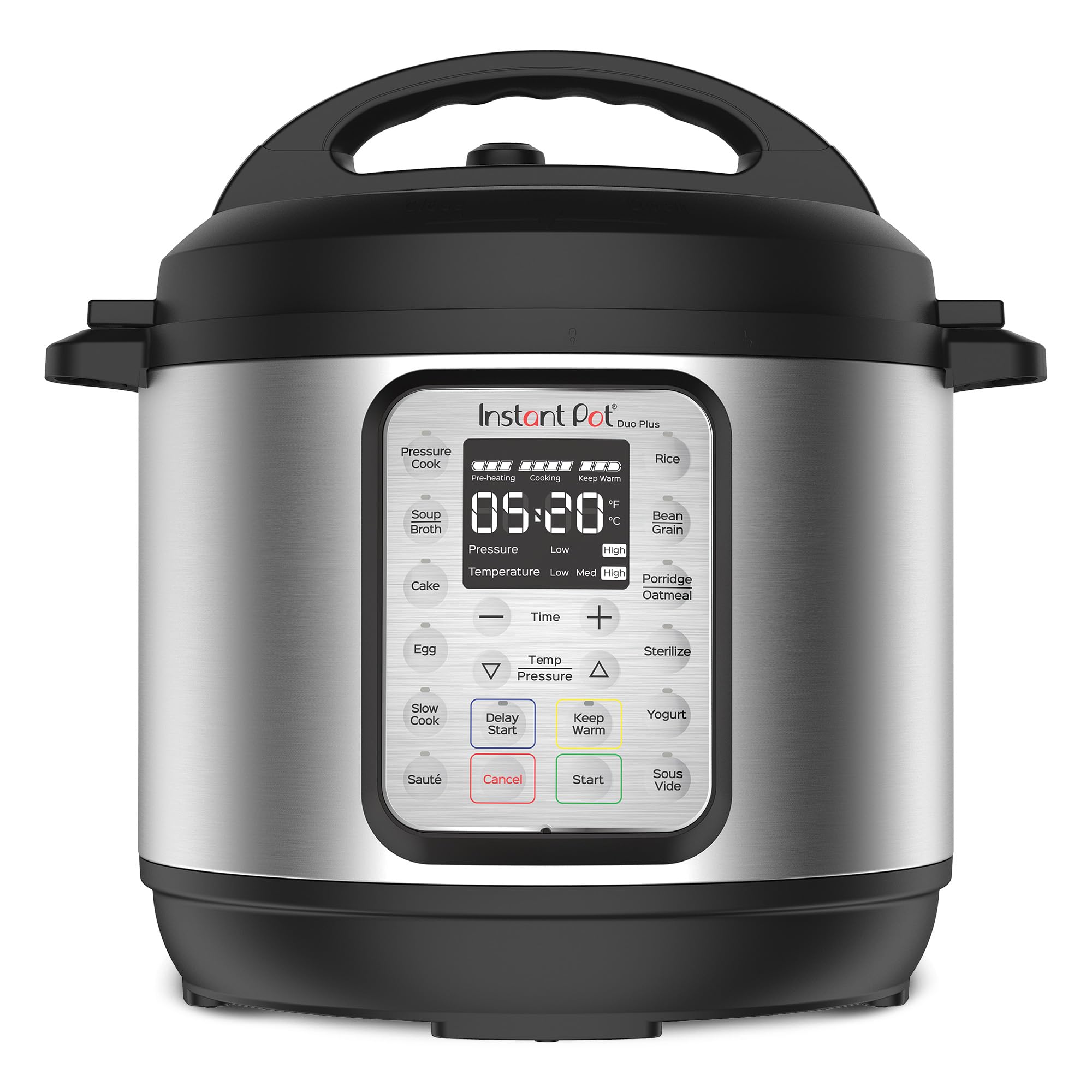
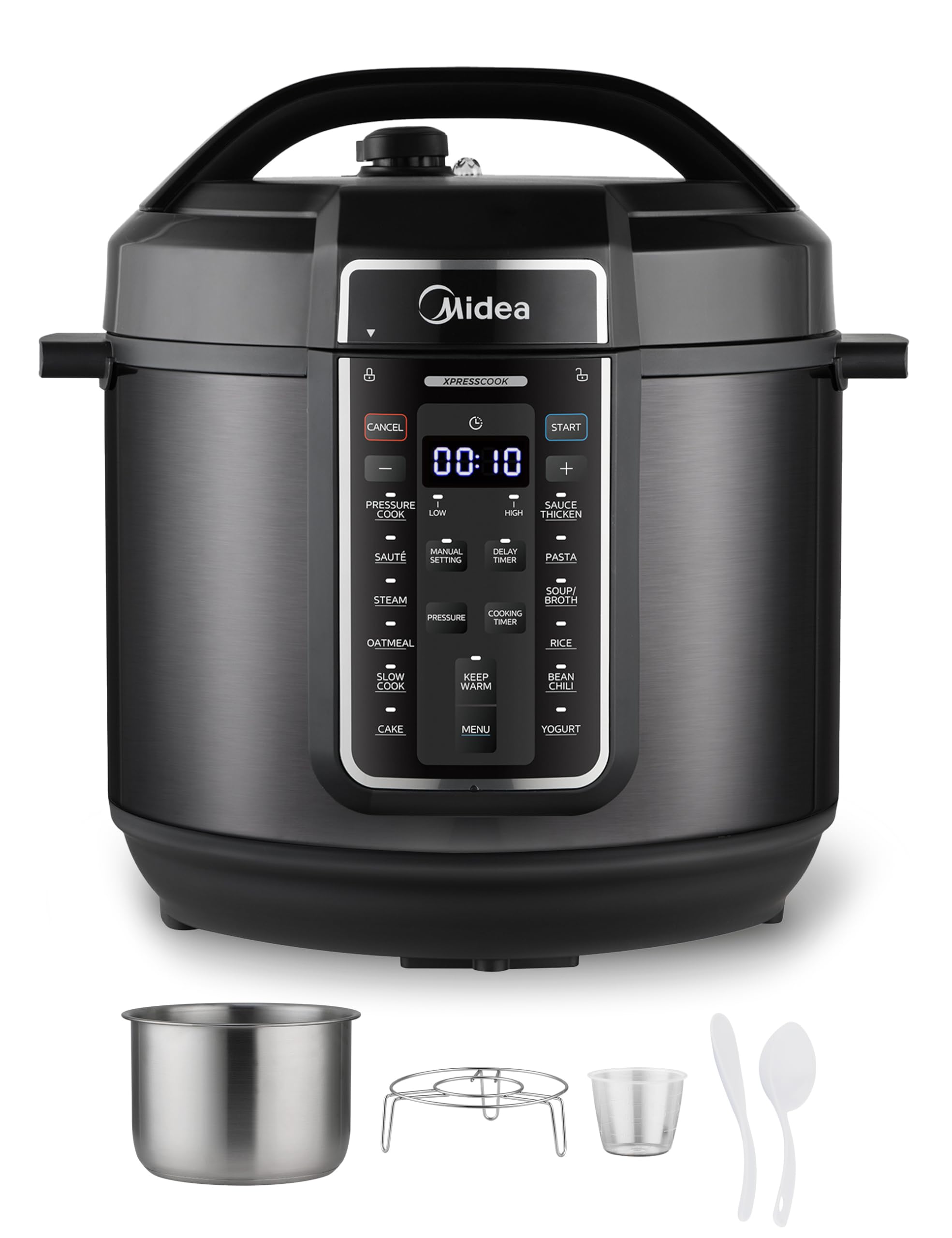
Two multicookers, two very different risk profiles. The Midea 12-in-1 Electric Pressure Cooker is cheaper, bigger (8 quarts vs 6), and claims more functions on paper. The Instant Pot Duo Plus 9-in-1 Multicooker costs more but has 52,000+ buyer ratings behind it. Here's the catch: the Midea has fewer than 1,000 ratings, so we have far less data to go on, and that shapes almost every part of this comparison.
The Quick Verdict on These Two Multicookers
The Instant Pot Duo Plus is the safer pick. We've got 52,000 buyers worth of data and a decade-long reliability profile. The Midea is cheaper and offers more presets on paper, but the picture is too thin to recommend it as a default. Pick the Midea only if you've read enough independent buyer feedback to feel confident, or if 8 quarts is the feature you can't live without.
Both cookers sit around 4.6 stars. Both use stainless steel inner pots. Both hit most of the same core functions (pressure cook, slow cook, saute, steam, rice, yogurt). The gap between them is not really about features. It's about what you can verify before you buy.
Functions and Capacity: How the Midea and Instant Pot Compare
On the spec sheet, the Midea wins the function count at 12 vs the Duo Plus at 9. In practice, most multicooker buyers use three or four functions: pressure cook, slow cook, saute, and rice. Everything else is marketing surface area. Yogurt mode exists on both. Steam exists on both. The Duo Plus adds sous vide and sterilize, which the Midea does not list. The Midea counters with bean/chili and oatmeal presets, which are really just pressure-cook timers with different labels.
Capacity is the more meaningful difference. The Midea is 8 quarts. The Duo Plus tested here is 6 quarts. For a household of two or three cooking weeknight meals, 6 quarts is already oversized for most recipes, and 8 quarts can be harder to fill to the minimum liquid line for pressure cooking. For a family of five or six, or anyone who batch-cooks chili and stock, 8 quarts is the right answer and the Duo Plus in this size would cost more anyway.
Build quality is where buyer data starts to matter. Instant Pot buyers consistently mention the 18/8 stainless inner pot and the anti-spin tri-ply bottom holding up past the first year. Midea buyers say the stainless pot feels solid, but with fewer than 1,000 ratings, we can't tell you whether that holds up at scale or whether early units are representative. That's not a knock on Midea. It's just math.
One more note on functions: neither machine is an air fryer. If you want crisping, skip both and look at an Instant Pot Duo Crisp or a Ninja Foodi instead.
What the Reviews Tell Us About Each Multicooker
This is where the two products stop being comparable on equal terms. The Instant Pot Duo Plus has north of 52,000 ratings and sells roughly 8,000 units a month. That is a lot of buyer signal. When we scanned the review pattern, the consistent themes were reliability past the one-year mark, the huge ecosystem of recipes and third-party accessories, and the app with 800+ recipes that buyers seem to use. Complaints center on the sealing ring picking up smells and occasional display failures, both known issues with known fixes.
The Midea has 879 ratings and moves around 600 units a month. That sounds fine in isolation. It is not fine when you're trying to answer the question "will this still work in 18 months." With fewer than 1,000 ratings, we can't spot reliability patterns the way we can with 52,000. Early ratings on any product skew positive because the only people writing reviews in month one are the people who just unboxed it and haven't had it fail yet. Our read is: the Midea's 4.6 stars might hold up, but we have no way to verify that from the data we have.
This is the asymmetry buyers keep underestimating. A higher star rating on a smaller sample is not the same as a higher star rating on a huge one. The Instant Pot's 4.6 stars from 52,000 buyers is a statement. The Midea's 4.6 stars from under 900 buyers is a starting point.
If you want to close the gap, read outside Amazon. Look for YouTube durability tests filmed after months of use, Reddit r/instantpot threads, and any independent kitchen blog that has used the Midea for more than a month. If you can't find those, treat it as a bet.
Price and Value: Midea vs Instant Pot Duo Plus
The Midea lists around $100. The Instant Pot Duo Plus has bounced between $100 and $200 over the past year and sits closer to $140 as a fair average. Call it a $40 gap in the Midea's favor at typical pricing, sometimes more, sometimes less.
On a pure quart-per-dollar basis, the Midea wins cleanly. Eight quarts for around $100 works out to roughly $13 per quart. The Duo Plus at 6 quarts and $140 comes in north of $23 per quart. If capacity is what you're buying, the math is not close.
On a per-known-issue basis, the Instant Pot wins. You know exactly what you're getting: the sealing ring smell, the occasional display complaint, the rock-solid pressure cook function, the recipe community, the replacement parts available everywhere. The $40 markup is paying for certainty. Whether certainty is worth $40 depends on how much you hate buying kitchen appliances twice.
Who Should Buy Which Multicooker
The Instant Pot Duo Plus is the right call for first-time multicooker buyers, anyone cooking for two to four people, and anyone who values the recipe community and the pile of third-party accessories (silicone lids, extra sealing rings, tempered glass lids). It is also the right call if you cannot afford to gamble on an appliance that might quietly fail at month 14 with no easy way to confirm whether that's common.
The Midea 12-in-1 is the right call if you specifically need 8 quarts, have read independent reviews beyond Amazon, and are comfortable treating it as a value bet rather than a known quantity. The quart-per-dollar math is in its favor, and nothing about the spec sheet looks alarming. It just has not been tested by enough buyers yet for us to stand behind it the way we can stand behind the Instant Pot.
If your budget can stretch past $150, the better move might be neither of these: look at the Instant Pot Duo Crisp, which adds air-fry functionality and solves more problems in one box.
Bottom Line on the Instant Pot vs Midea Multicooker Match-Up
Buy the Instant Pot Duo Plus unless you have a specific reason not to. The 52,000+ ratings, the track record past year one, and the ecosystem are worth the $40 gap for most buyers. The Midea is a fair-looking deal and might turn out to be a great one, but with fewer than 1,000 ratings we can't promise that, and neither should anyone else.